
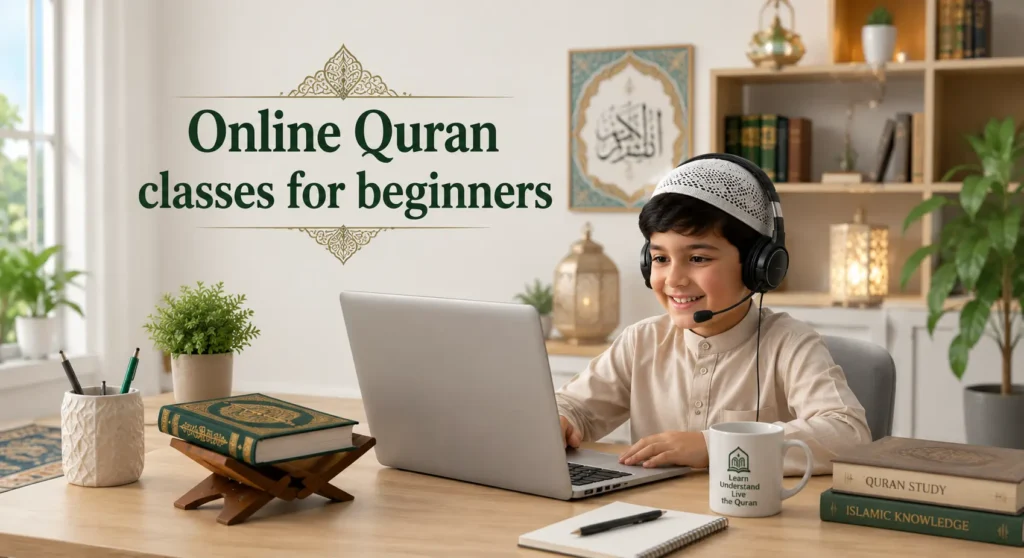
Direct answer: Beginners can start learning the Quran online by completing a reading assessment, selecting a suitable beginner course, attending live lessons with a qualified tutor, and following a regular revision routine. Complete beginners should normally start with Arabic letters or Noorani Qaida before progressing to Quran reading and Tajweed.
Starting Quran learning can feel difficult when a student cannot recognize Arabic letters or pronounce Quranic words accurately. However, previous knowledge of Arabic is not required.
Online Quran classes for beginners introduce Quran reading through a clear learning sequence. Students begin with Arabic letters, correct sounds, vowel marks, joined forms, short words, and basic pronunciation rules. A live teacher listens to the learner and corrects errors during each lesson.
Online education can also improve access to teachers and provide greater scheduling flexibility. UNESCO states that digital innovation can expand access to educational opportunities and support more inclusive learning pathways when students have suitable technology and teacher guidance.
To understand the wider advantages of accessibility, flexible schedules, and home-based learning, read the parent guide on why learn Quran online. This supporting article focuses specifically on how beginners should start, practise, and progress.
What Are Online Quran Classes for Beginners?
Online Quran classes for beginners are live, teacher-led lessons for students with little or no previous Quran-reading experience.
These classes are suitable for children, adults, new Muslims, and learners returning to Quran study after a long break. Lessons normally take place through video-conferencing software using a computer, tablet, or smartphone.
During each class, the tutor demonstrates Arabic sounds, asks the student to repeat them, and corrects pronunciation mistakes. The learner may use a printed or digital Qaida while the tutor follows the same lesson.
Live lessons differ from recorded videos because a recording cannot evaluate the learner’s voice. A qualified tutor can identify whether a sound is being produced correctly and explain how the learner should improve it.
Quranic Path currently provides personalized online classes for children and adults, including Quran reading and Tajweed programs.
Who Can Join Beginner Quran Lessons Online?
Beginner Quran lessons are suitable for anyone who needs help recognizing Arabic letters, joining words, improving pronunciation, or restarting Quran reading.
A complete beginner may start from the Arabic alphabet. Another learner may recognize letters but struggle to read connected words. Some adults can read slowly but need help correcting mistakes learned during childhood.
Children usually benefit from shorter lessons and repeated practice. Adults may prefer detailed explanations and a schedule arranged around work or family responsibilities.
The correct starting point should depend on the learner’s present ability rather than age.
Which Quran Course Should a Beginner Choose First?
The correct course depends on whether the student can recognize letters, connect words, and read Quranic verses. A short level assessment helps the teacher select an appropriate starting point.
| Current Reading Ability | Recommended Learning Path |
| Cannot recognize Arabic letters | Qaida for Beginners |
| Recognizes letters but cannot join words | Guided Noorani Qaida lessons |
| Reads words slowly but lacks fluency | Learn Quran Reading Online |
| Reads verses but makes pronunciation errors | Learn Quran with Tajweed |
The Quran reading course is described as suitable for complete beginners and improving learners who need structured guidance from Arabic letters to fluent reading.
Beginners should not skip foundational lessons simply because they want to progress quickly. An incorrectly learned letter sound can affect every word containing that letter.
How Can Beginners Start Learning the Quran Step by Step?
Beginners should move gradually from individual Arabic sounds to complete Quranic verses.
A practical learning process includes these 7 stages:
- Complete an initial reading assessment.
- Learn Arabic letters and their articulation points.
- Study Fatha, Kasra, Damma, and other vowel signs.
- Practise joined letters and short Arabic words.
- Learn Sukoon, Shaddah, Tanween, and Madd.
- Read short Quranic verses with live correction.
- Apply basic Tajweed rules during recitation.
Students do not complete every stage at the same speed. A learner who remembers some Arabic letters may progress faster than someone starting from zero.
The objective is not to finish a Qaida quickly. The learner should be able to recognize letters, pronounce sounds correctly, and apply previous lessons without continuous prompting.
Why Should Beginners Start with Noorani Qaida?
Noorani Qaida provides a structured foundation for Arabic letters, vowel marks, connected words, and Quranic pronunciation.
The Qaida normally begins with separate Arabic letters. It then introduces connected forms, short vowels, Tanween, Sukoon, Shaddah, Madd, and common Quranic reading patterns.
This method helps beginners understand how Arabic words are constructed instead of memorizing every word as an individual shape.
Qaida lessons also help learners distinguish between similar sounds. Examples include س and ص, ت and ط, ح and ه, and ق and ك. These letters may sound alike to a beginner but originate from different articulation points.
A live tutor can demonstrate each sound, listen to the student’s attempt, and correct the pronunciation before the mistake becomes a repeated habit.
What Happens During the First Online Quran Class?
The first online Quran class usually includes a reading assessment, tutor introduction, learning-goal discussion, and short sample lesson.
A complete beginner may be asked to identify several Arabic letters. A student with previous experience may read from a Qaida or recite a short Surah.
The tutor uses this assessment to identify specific strengths and difficulties. One learner may recognize every letter but struggle with connected forms. Another may read complete verses but pronounce several letters incorrectly.
The teacher should then recommend a suitable course, starting lesson, and class frequency. Quranic Path’s Quran-reading page also describes an evaluation class used to assess the learner and recommend an appropriate course.
The first lesson also allows students to evaluate the teacher’s pronunciation, patience, communication, audio quality, and teaching method.
How Do One-to-One Quran Lessons Help Beginners?
One-to-one Quran lessons give beginners more reading time, direct correction, and a lesson pace based on their needs.
In a group class, a teacher must divide attention between several students. During a private lesson, the learner can repeat difficult sounds and words without waiting for other participants.
Personal instruction also allows the tutor to adjust the lesson. A student struggling with one letter can spend more time practising it, while a learner with previous knowledge can move forward sooner.
This immediate correction is especially important because beginners may not recognize their own pronunciation mistakes. The teacher can identify the error, demonstrate the correct sound, and listen to another attempt.
How Often Should Beginners Study and Practise?
Most beginners can start with two or three live Quran lessons each week and complete short revision sessions between classes.
Children may benefit from lessons lasting 20–30 minutes, while adults may select 30–45-minute sessions according to their concentration and schedule.
A learner who attends several classes but never revises may struggle to remember letter shapes, sounds, and reading rules. Consistency is more important than studying for several hours on one day.
A practical routine may include 10–15 minutes of revision on non-class days. The student should repeat the exact letters, words, or verses assigned by the tutor instead of moving to random advanced lessons.
Learners can compare different weekly lesson options on the Quran class fees and plans page. The current page lists several class-frequency options, including two, three, four, and five days per week.
What Should Beginners Practise Between Lessons?
Beginners should focus on accuracy, repetition, and previous lesson review.
Practice may include repeating difficult letters, reading one Qaida line several times, listening to an assigned recitation, or recording the learner’s voice for comparison.
Students should read slowly before trying to increase speed. Slow reading with correct pronunciation is more useful than fast reading with repeated errors.
Revision should also include earlier lessons. Constantly moving to new pages without reviewing previous material can create weak letter recognition and inconsistent pronunciation.
Parents can help children by checking the assigned page and preparing the device before class. Adults can connect practice with an existing daily habit, such as after Fajr, Maghrib, or before sleeping.
When Should Beginners Start Learning Tajweed?
Correct pronunciation should begin from the first lesson, while detailed Tajweed rules should be introduced gradually as reading ability improves.
A complete beginner does not need to memorize every technical Tajweed definition before reading. The first priority should be correct Arabic sounds, vowel lengths, joined words, and clear pronunciation.
As the student begins reading Quranic verses, the tutor can introduce rules such as Madd, Ghunnah, Qalqalah, Ikhfa, and Idgham.
This gradual approach makes Tajweed easier to understand because the student applies each rule to words they can already read.
Learners who complete the basic reading stage can progress to the Learn Quran with Tajweed course. The program covers Makharij, letter characteristics, Madd, stopping rules, pronunciation, and recitation practice.
How Can Adults and Parents Support Beginner Learning?
Adults should begin at their actual level, while parents should help children maintain a simple and consistent learning routine.
Adults sometimes delay Quran learning because they feel embarrassed about starting with basic letters. Private online lessons provide a comfortable environment where they can ask questions and repeat difficult sounds without comparison with a group.
An adult can begin with one measurable goal, such as learning the Arabic alphabet, correcting Surah Al-Fatihah, or reading short Surahs accurately.
Parents can support children by creating a quiet study space, preparing the device, checking homework, and communicating with the teacher. They should encourage careful practice rather than placing pressure on the child to finish pages quickly.
How Should Beginners Choose an Online Quran Teacher?
A suitable beginner Quran tutor should have accurate recitation, patience, clear communication, and experience teaching foundational skills.
Before enrollment, learners should confirm that the teacher provides a level assessment, live pronunciation correction, regular feedback, revision tasks, and a structured curriculum.
Parents should ask how children’s lessons are monitored and how progress is communicated. Women and girls may also confirm whether a female tutor is available.
A trial lesson can help the learner evaluate the teacher’s method before choosing a regular schedule. Students can also read the guide to selecting the best online Quran classes for additional comparison points.
How Long Does It Take a Beginner to Read the Quran?
There is no fixed completion time because each learner starts at a different level and follows a different practice routine.
Progress depends on age, previous Arabic exposure, lesson frequency, pronunciation ability, teacher support, and revision consistency.
The most useful measure is not the number of weeks completed. A beginner is progressing when they can recognize letters, connect words, remember previous lessons, and read unfamiliar material with less assistance.
Promises that every learner will become fluent within a fixed number of days should be treated carefully.
How Can Beginners Start Learning Quran Online Today?
Beginners can start by completing an assessment, choosing the recommended course, selecting suitable lesson times, and attending a live introductory class.
Students who cannot recognize Arabic letters should begin with Qaida. Learners who can form words but lack fluency should choose Quran-reading lessons. Students who already read but make pronunciation mistakes can progress to Tajweed.
Beginners can register for online Quran classes and use the introductory lessons to assess the tutor, course level, schedule, and teaching method.
The best way to start learning the Quran online is to begin at the correct level, attend consistently, and improve one letter, word, and verse at a time.