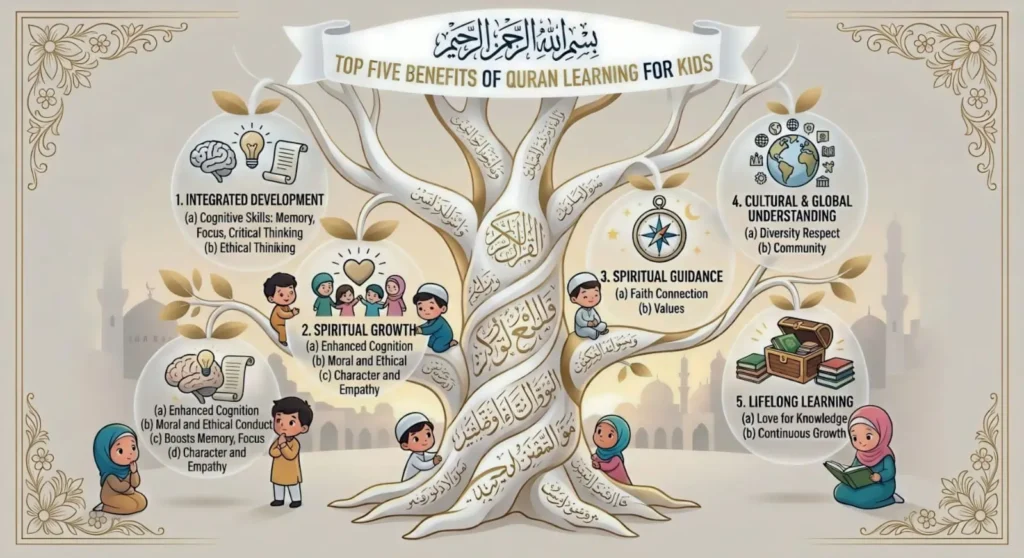
The top 5 benefits of Quran classes for kids include learning correct Quran recitation, understanding basic Islamic teachings, building discipline, improving confidence, and developing a lifelong connection with the Book of Allah. These classes offer much more than simply reading Arabic words. A good Quran class teaches children how to pronounce letters correctly, follow Tajweed rules, memorize selected Surahs, understand Islamic manners, and develop a consistent daily learning routine.
For Muslim parents in the USA, UK, Canada, Australia, and other countries, online Quran classes make Quran learning easier because children can study from home with qualified teachers. Quranic Path Academy offers Online Quran Classes for Kids through live one-on-one lessons, flexible schedules, Tajweed practice, and beginner-friendly guidance.
Why Do Quran Classes Build Strong Quran Reading Skills?
The first benefit of Quran classes for kids is accurate Quran reading. Children need step-by-step guidance because Quran reading includes Arabic letters, Harakat, Makharij, fluency, pauses, and pronunciation rules. Without a teacher, many children repeat reading mistakes for months or years.
A structured class starts with basics. Beginners learn Arabic letters, short vowels, long vowels, Sukoon, Shaddah, Madd, and letter joining. These basics help children read words correctly before they move to full verses. Parents who want a foundation-based program can start with Learn Noorani Qaida Online, because Noorani Qaida helps kids understand correct pronunciation from the beginning.
Research on learning supports structured and spaced practice because children remember better when learning is divided into repeated sessions instead of one long session. The Institute of Education Sciences recommends spacing learning over time for stronger retention. This method fits Quran learning because children improve through regular short lessons, teacher correction, and home revision.
How Do Quran Classes Improve Tajweed and Pronunciation?
The second benefit is Tajweed improvement. Tajweed means reciting the Quran with proper pronunciation, correct letter sounds, and rules that protect the meaning of the words. Kids often struggle with Arabic sounds such as ع, غ, ق, خ, ح, and ص because these letters do not exist in many local languages.
In a live Quran class, the teacher listens carefully and corrects the child instantly. This direct correction helps the child understand the difference between similar letters, such as س and ص or ت and ط. The child also learns basic Tajweed rules, including Ikhfa, Idgham, Qalqalah, Ghunnah, and Madd.
Parents who want a focused Tajweed program can explore Online Quran Classes With Tajweed or read the guide on how to learn Quran with Tajweed online step by step. Teacher feedback is important because feedback helps learners identify mistakes, understand weak areas, and improve future performance. The Education Endowment Foundation reports that feedback can support learning when it explains misconceptions and guides improvement.
How Do Quran Classes Support Hifz and Memory Development?
The third benefit is stronger memorization. Quran classes help kids memorize Surahs, daily duas, and selected verses with a proper revision plan. Memorization is not only repeating words. It needs correct recitation, regular revision, teacher listening, and parent support.
A good Hifz routine includes 3 parts: Sabaq, Sabqi, and Manzil. Sabaq is the new lesson. Sabqi is the recently memorized portion. Manzil is the older revision. This system helps children protect previous lessons while learning new verses.
For children who are ready for memorization, parents can visit Hifz Quran Online or read Best Online Quran Hifz Classes for Kids. These resources help parents understand how online Hifz classes use teacher support, revision targets, and Tajweed correction.
Learning science also supports retrieval practice. The American Psychological Association explains that remembering information more than once helps learners retain knowledge. This applies to Quran memorization because children strengthen memory when they recite learned verses repeatedly to a teacher.
How Do Quran Classes Build Discipline and Daily Islamic Routine?
The fourth benefit is discipline. Children learn better when they have a fixed learning routine. Quran classes create a daily or weekly schedule that teaches punctuality, attention, respect for the teacher, and responsibility for homework.
A 30-minute Quran class can build many habits. These habits include sitting with focus, opening the Mushaf on time, revising the previous lesson, listening to correction, and completing assigned practice. Over time, children understand that Quran learning is part of daily life, not a one-time activity.
Online classes make this routine easier for busy families. Parents do not need travel time, and children can learn after school, on weekends, or during suitable family hours. Quranic Path explains its class options and monthly plans on the Fees page, which helps parents choose a schedule according to the child’s routine.
This benefit is especially useful for Muslim families living in non-Muslim-majority countries. When children study Quran consistently at home, they stay connected to Islamic learning while managing school, sports, and family activities.
How Do Quran Classes Increase Confidence and Islamic Understanding?
The fifth benefit is confidence. Many kids feel shy when they cannot read fluently. They may avoid reciting in front of parents, siblings, or teachers. Quran classes reduce this fear because children practice in a safe one-on-one setting.
When a teacher corrects gently, the child learns without embarrassment. After a few weeks of regular practice, many children start reading more clearly, recognizing words faster, and reciting with better flow. This confidence also helps during Salah, family recitation, Ramadan routines, and Islamic school activities.
Quran classes also introduce children to Islamic values. Lessons may include short explanations of Surahs, stories of Prophets, duas, manners, and moral lessons. Examples include honesty, patience, gratitude, kindness, and respect for parents. For older children who want meaning-based learning, parents can explore the Tafseer-Ul-Quran Course or the Learn Quran Reading program.
Which Quran Class Is Best for Your Child?
The best Quran class depends on the child’s current level. Beginners need Noorani Qaida. Children who can read but make mistakes need Tajweed. Children with fluent reading can start Hifz. Children who want meaning can study translation or Tafseer.
| Child’s Need | Best Option |
| Arabic letters and basics | Learn Noorani Qaida Online |
| Reading fluency | Learn Quran Reading |
| Correct pronunciation | Online Quran Classes With Tajweed |
| Memorization | Hifz Quran Online |
| Kids’ complete learning | Online Quran Classes for Kids |
Parents in the USA can also read What Are the Best Online Quran Classes for Kids in USA? for location-specific guidance.
How Can Parents Start Quran Classes for Kids Today?
Parents can start by checking the child’s level, choosing the right course, and booking a trial lesson. If the child is a beginner, start with Qaida. If the child reads slowly, choose Quran reading. If the child mispronounces letters, choose Tajweed. If the child reads fluently and has strong discipline, choose Hifz.
Quran classes for kids give 5 clear benefits: correct reading, better Tajweed, stronger memorization, daily discipline, and Islamic confidence. These benefits help children connect with the Quran in childhood and continue that connection throughout life. To begin, parents can use the Register page and choose the most suitable Quran learning path for their child.