
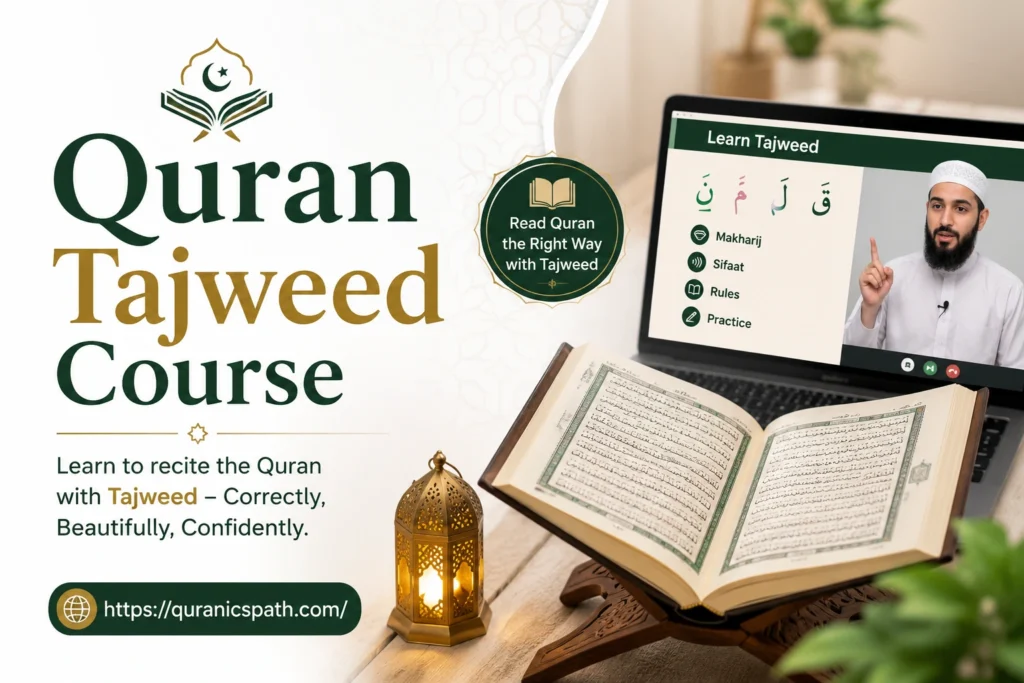
What Is a Quran Tajweed Course?
The best Quran Tajweed Course teaches students how to recite the Holy Quran with correct pronunciation, proper letter sounds, and accurate recitation rules. Tajweed means giving every Arabic letter its correct right during recitation. It helps the student pronounce letters from their correct places and apply the right sound, length, pause, and rhythm.
This course is useful for kids, adults, beginners, reverts, and students who can already read the Quran but still make pronunciation mistakes. Many learners read Arabic words from the Mushaf, but they struggle with Makharij, Sifaat, Madd, Ghunna, Qalqalah, and Waqf. A Quran Tajweed Course solves these problems through live correction, guided practice, and regular revision.
Students who want focused Tajweed learning can join the Learn Quran with Tajweed course at Quranics Path Academy. This program helps learners improve Quran recitation from home with qualified Quran teachers.
Why Is a Quran Tajweed Course Important?
A Quran Tajweed Course is important because Quran recitation depends on correct sound and pronunciation. Arabic letters have specific articulation points. Some letters come from the throat, some from the tongue, some from the lips, and some from the nasal passage. If these sounds are not pronounced correctly, the recitation becomes weak and unclear.
Tajweed helps students avoid common mistakes in Quran recitation. It teaches how long a vowel should be stretched, when Ghunna should be applied, how heavy letters should be pronounced, and where the student should stop during recitation. This makes Quran recitation more fluent, accurate, and respectful.
A student who learns Tajweed does not rush through verses. The student listens carefully, repeats sounds, and corrects mistakes with teacher support. This method builds confidence and helps the learner recite the Quran with more focus and care.
Who Can Join a Quran Tajweed Course?
A Quran Tajweed Course is suitable for students of different ages and levels. Children can join after learning Arabic letters or basic Qaida. Adults can join even if they learned Quran reading many years ago. Beginners can start from Arabic letters, while intermediate learners can focus on Tajweed rules and correction.
| Student Type | Learning Need | Course Focus |
| Kids | Easy Quran reading Letters | short Surahs, basic Tajweed |
| Adults | Mistake correction | Makharij, Madd, Ghunna, fluency |
| Beginners | Strong foundation | Qaida, Harakat, Sukoon, Tanween |
| Intermediate students | Rule application | Noon Saakin, Meem Saakin, Qalqalah |
| Advanced students | Recitation mastery | Full Quran recitation and Ijazah preparation |
The best Tajweed course does not teach every student in the same way. Kids need short lessons and repetition. Adults need clear explanation and correction. Advanced students need detailed feedback and consistent recitation review.
What Will You Learn in a Quran Tajweed Course?
In a Quran Tajweed Course, students learn the main rules that control correct Quran recitation. The course usually starts with Makharij, which means the articulation points of Arabic letters. This topic teaches where each letter comes from and how the mouth, tongue, throat, and lips should work during pronunciation.
After Makharij, students learn Sifaat. Sifaat means the qualities of Arabic letters. Some letters are heavy, some are light, some have a strong sound, and some have a soft sound. When students understand Sifaat, their recitation becomes clearer and more controlled.
| Tajweed Topic | What It Teaches |
| Makharij | Correct place of letter pronunciation |
| Sifaat | Letter qualities and sound control |
| Noon | Saakin and Tanween Izhar, Idgham, Iqlab, and Ikhfa |
| Meem Saakin | Ikhfa Shafawi, Idgham Shafawi, Izhar Shafawi |
| Madd | Correct stretching of vowel sounds |
| Qalqalah | Echoing sound in specific letters |
| Waqf | Correct stopping and starting during recitation |
These rules are practiced directly in Quranic verses. This practical method helps students move from theory to real recitation.
Key Features of Online Tajweed Courses
Online Tajweed courses offer a structured approach to help students recite the Quran correctly from anywhere in the world.
Live Teacher Correction: Students recite in real-time, and qualified teachers from Quranics Path Academy correct pronunciation, Madd, Ghunna, Qalqalah, and stopping rules.
Flexible Schedule: Classes are scheduled according to the student’s availability, making them suitable for children, adults, and working learners.
Step-by-Step Learning: Courses begin with the basics, such as Arabic letters and Harakat, and gradually progress to advanced Tajweed rules and full Quran recitation.
Personalized Attention: Small-group or one-to-one sessions allow teachers to focus on each student’s mistakes and improvement areas.
Practical Recitation: Students apply Tajweed rules directly while reciting Quranic verses, ensuring theoretical knowledge is reinforced through practice.
Suitable for All Levels: Beginners, intermediate learners, and advanced students follow the same structured path with adjustments based on their current skill level.
This setup ensures learners from Quranics Path Academy gain accurate, confident, and fluent Quran recitation while receiving continuous guidance.
How Does an Online Quran Tajweed Course Work?
An online Quran Tajweed Course works through live classes with a qualified Quran teacher. The student joins the class through a mobile phone, tablet, or computer. The teacher listens to the student’s recitation, identifies mistakes, explains the rule, and asks the student to repeat the verse correctly.
A normal class includes revision, rule explanation, recitation practice, and teacher feedback. The student may revise the previous lesson first. After that, the teacher introduces a new Tajweed rule or continues practical recitation from the Quran. During recitation, the teacher corrects pronunciation, Madd length, Ghunna sound, Qalqalah, and stopping mistakes.
Online learning is helpful for students who want flexible Quran classes from home. Parents can arrange Tajweed classes for kids without travel. Adults can choose timings according to work, study, or family routine.
How Should Beginners Start Learning Tajweed?
Beginners should start learning Tajweed from basic Arabic sounds and simple Quran reading. A new learner should not jump directly into advanced rules because Tajweed depends on correct pronunciation first. If the student cannot recognize letters or vowels properly, the teacher should begin with Qaida, Harakat, Sukoon, Shaddah, and Tanween.
Students who need basic reading support can start with the Learn Quran Reading program before moving to detailed Tajweed rules. This helps beginners build a strong foundation and makes advanced recitation easier.
A beginner should focus on slow and correct reading. Speed should come later. The first target is to pronounce letters correctly, recognize common mistakes, and apply simple rules during short Surahs.
How Long Does It Take to Learn Tajweed?
The time required to learn Tajweed depends on the student’s level, class frequency, teacher feedback, and daily practice. A beginner may need more time because they must first learn Arabic letters and basic Quran reading. A student who already reads the Quran can usually progress faster.
Many students understand basic Tajweed rules within a few months. However, applying those rules naturally during recitation takes more practice. For example, a student may know the rule of Madd but still shorten vowels while reading. This is why teacher correction is necessary.
Daily practice is more effective than long lessons without revision. Even 15 to 20 minutes of daily recitation can improve pronunciation, fluency, and confidence.
How Can Kids Learn Quran Tajweed Easily?
Kids learn Quran Tajweed better when lessons are short, simple, and interactive. A child should not receive too many rules in one class. The teacher should explain one rule at a time and use easy examples from short Surahs.
Children learn well through listening and repetition. The teacher recites first, and the child repeats after listening carefully. This method helps the child copy the correct sound. Letter charts, simple mouth-position examples, and gentle correction also help children understand Makharij and Sifaat.
Parents can support children by setting a fixed Quran practice time at home. A short daily routine is better than a long lesson once a week. Families looking for structured Quran education can also explore our Online Quran Classes for Kids in USA, where children learn Quran reading, Tajweed, and Islamic studies with qualified tutors.
How Can Adults Improve Quran Recitation With Tajweed?
Adults can improve Quran recitation by identifying repeated mistakes and correcting them with a qualified teacher. Many adults can read the Quran, but they may still have old pronunciation habits. Some learners pronounce ق like ك, mix ع with أ, or skip proper Ghunna during recitation.
Adult learners usually understand Tajweed rules faster than children, but they need consistent practice to apply those rules while reading. Recording recitation, repeating corrected verses, and revising daily can help adults improve faster.
What Are the Most Common Tajweed Mistakes?
Common Tajweed mistakes happen when students read without knowing the correct sound, rule, or vowel length. Some students mix similar Arabic letters. Others stretch short vowels too long or shorten Madd letters. Some students skip Ghunna or stop at the wrong place.
Common mistakes include mixing ح and ه, mixing ع and أ, pronouncing ق like ك, ignoring Ghunna in Noon and Meem Mushaddad, shortening Madd letters, making weak Qalqalah sounds, and stopping without understanding Waqf signs.
These mistakes can be corrected through listening, repetition, and live teacher feedback. The teacher identifies the mistake, explains the correct sound, and helps the student repeat it until pronunciation improves.
What Is the Difference Between Quran Reading and Quran Tajweed?
Quran reading means reading Arabic words from the Mushaf. Quran Tajweed means reciting those words with correct pronunciation, sound quality, vowel length, nasal sound, and stopping rules. A student may be able to read the Quran but still need Tajweed correction.
Basic Quran reading helps the student recognize words. Tajweed improves how those words are pronounced. For example, reading tells the student what the word is. Tajweed teaches how the word should sound.
This difference is important because Quran learning does not end at basic reading. Correct recitation needs Tajweed, listening, teacher correction, and regular practice.
Can You Learn Tajweed Online Effectively?
Yes, Tajweed can be learned online effectively when the course includes live classes, teacher correction, structured lessons, and regular practice. Tajweed is a sound-based subject, so the student must recite aloud and receive feedback.
Online learning works well when the teacher listens carefully and corrects mistakes in real time. The student should also follow a clear course plan that starts with pronunciation and moves toward full recitation practice.
Students who want more Quran learning guidance can also read helpful articles on the Quranics Path Blog. Blog content can support students with Quran learning tips and online class guidance.
What Should You Check Before Joining a Quran Tajweed Course?
Before joining a Quran Tajweed Course, students should check the teacher, curriculum, class format, schedule, and feedback system. A good course should be practical, structured, and suitable for the student’s level.
The teacher should have correct recitation and strong Tajweed knowledge. The curriculum should cover Makharij, Sifaat, Madd, Ghunna, Qalqalah, and Waqf. The class format should allow the student to recite in every lesson and receive direct correction.
A good course should not only teach rule names. It should help the student apply those rules while reading Quranic verses.
How Can You Start a Quran Tajweed Course?
You can start a Quran Tajweed Course by taking a short level assessment with a qualified teacher. The teacher checks your pronunciation, fluency, and current knowledge of Tajweed rules. After that, the teacher recommends the right starting point.
If you are a beginner, you may start with Arabic letters and Qaida. If you already read the Quran, you may start with Makharij, Sifaat, and basic Tajweed rules. If your recitation is fluent, you may focus on advanced correction or full Quran recitation.
Students who are ready to begin can use the Quranics Path Register page to request classes and start their Quran learning journey.
What is Tajweed in Quran?
Tajweed is the set of rules that govern the correct pronunciation, articulation, and recitation of the Quran. It ensures that every Arabic letter is pronounced from its correct place (Makharij), with the right characteristics (Sifaat), correct vowel length (Madd), and proper nasalization (Ghunna). Tajweed prevents mispronunciation, preserves the Quran’s meaning, and makes recitation clear, fluent, and respectful.
In simple terms, Tajweed means “to improve” or “to make something better”, applied to Quranic recitation to ensure each word is pronounced accurately according to classical Arabic rules.
Why is Tajweed important in Quran recitation?
Tajweed is important because it prevents pronunciation mistakes in Quran recitation. It helps preserve the correct sound of Arabic letters, vowel length, and meaning. With Tajweed, students recite the Quran more clearly, fluently, and confidently.
Can I learn Quran with Tajweed online?
Yes, you can learn Quran with Tajweed online through live classes with a qualified Quran teacher. The teacher listens to your recitation, corrects mistakes, and helps you practice rules like Makharij, Madd, Ghunna, and Qalqalah.
What are the basic rules of Tajweed?
The basic rules of Tajweed include Makharij, Sifaat, Madd, Ghunna, Qalqalah, Noon Saakin, Meem Saakin, and Waqf. These rules teach correct letter pronunciation, vowel stretching, nasal sound, echoing sound, and proper stopping.
How long does it take to learn Tajweed?
It usually takes a few months to learn basic Tajweed rules. The exact time depends on the student’s level, class schedule, teacher correction, and daily practice. Beginners may need more time because they first learn Arabic letters and basic Quran reading.
How Does a Quran Tajweed Course Improve Your Recitation?
The best Quran Tajweed Course improves Quran recitation by combining knowledge, listening, practice, and teacher correction. The student learns what each rule means, hears how it sounds, applies it in Quranic verses, and receives correction until the recitation improves.
This course is useful for kids, adults, beginners, and advanced learners. It builds a strong foundation in pronunciation and then develops fluency through practical recitation. Students who wish to continue their Quran journey after mastering Tajweed can explore our Quran Memorization Online program and Best Online Quran Hifz Classes for Kids to strengthen memorization alongside correct recitation.